

Subterranean vs Dampwood Termites: Key Differences Homeowners Should Know
When Australian homeowners hear the word “termite”, an immediate sense of anxiety usually follows. These destructive insects are responsible for more structural property damage across Australia than fires, floods, and storms combined. However, many property owners do not realise that termites are not a single, uniform threat. In fact, different species have distinct biological traits, nesting behaviours, and environmental requirements.
Two of the most common groups encountered across coastal and suburban regions are subterranean termites and dampwood termite species. While both consume wood, the way they attack your home, where they nest, and how they need to be treated are completely different. Misidentifying the type of termite on your property can lead to ineffective DIY treatments, wasted money, and ongoing structural devastation.
In this educational guide, we will break down the key differences between subterranean and dampwood termites, look at the critical connection between moisture and termites, and outline the essential steps for professional timber pest control, inspection, and structural restoration.
1. Defining the Species: Subterranean vs. Dampwood Termites
To effectively protect your home, you must first understand the core biological definitions of these two distinct families of wood-destroying pests.
Subterranean Termites (The Ground Dwellers)
Subterranean termites, primarily from the Rhinotermitidae family (including highly destructive species like Coptotermes and Schedorhinotermes), are the most widespread and aggressive property pests in Australia.
As their name suggests, these termites live underground. Their colonies are located deep within the soil, often built around the root systems of mature gum trees or buried timber stumps. A single subterranean colony can house millions of individuals, and their foraging networks can extend up to 100 metres away from the main nest. Because they are highly vulnerable to dehydration and open-air predators, they construct complex mud tubes to travel safely from the soil into your home’s structural framing.
Dampwood Termites (The Timber Inhabitants)
The dampwood termite (primarily from the Termopsidae and Kalotermitidae families, such as Porotermes adamsoni) follows a completely different survival strategy.
Unlike their subterranean cousins, dampwood termites do not typically nest in the soil and do not build underground mud networks. Instead, they live, eat, and breed entirely inside the specific piece of timber they are consuming. A colony is founded when a pair of winged swarmers locates a moisture-laden, decaying log or structural beam and bores directly inside, sealing the entry hole behind them. Their colony sizes are significantly smaller, usually consisting of just a few thousand individuals, but they can silently hollow out support structures from the inside out.
2. Structural and Physical Differences
Telling these two pests apart is straightforward once you know what to look for regarding their size, colour, and physical features.
Size Comparison
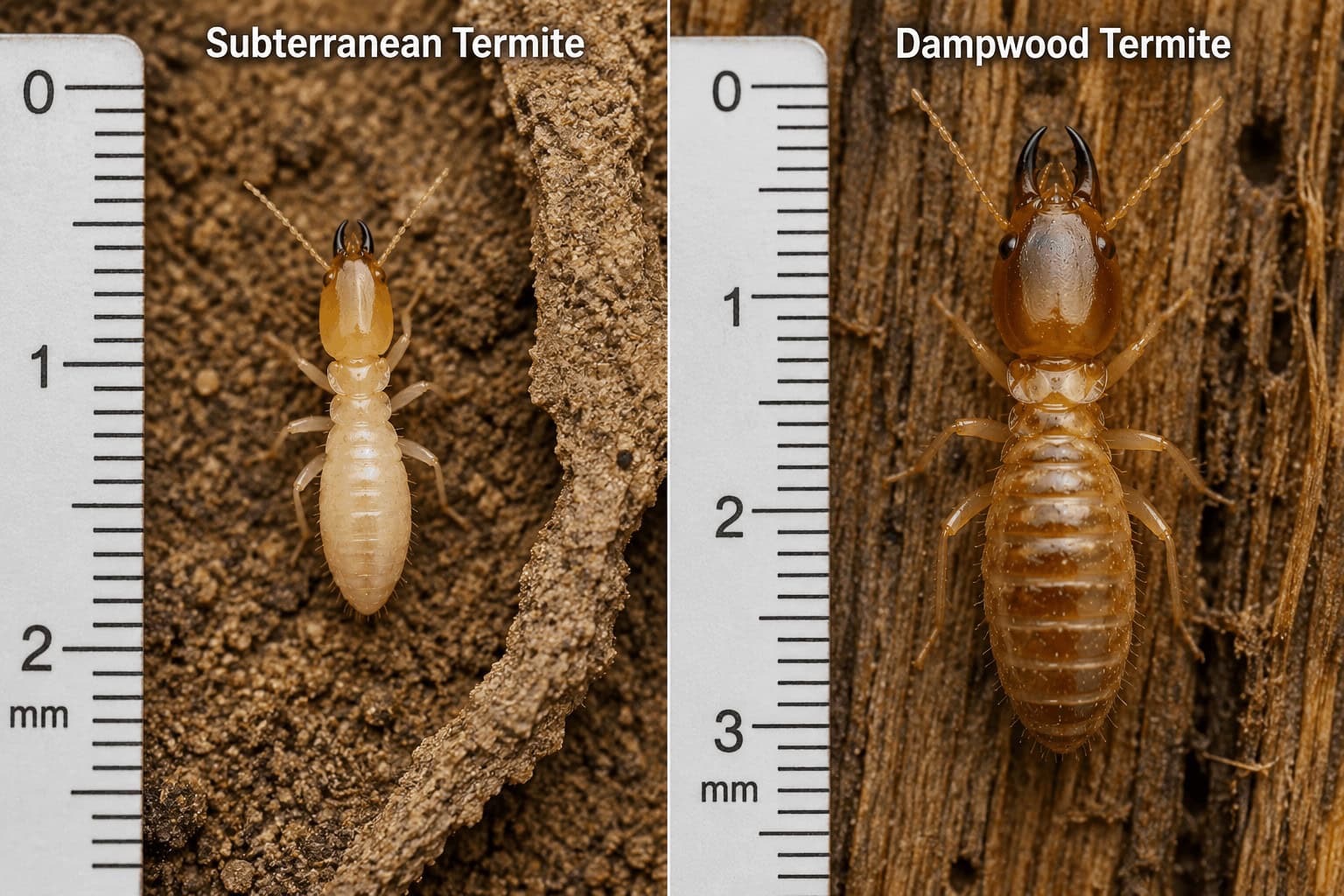
If you place the two species side-by-side, the size difference is striking. Dampwood termites are the absolute giants of the termite world.
- Subterranean Termites: Workers and soldiers are relatively small, usually measuring between 4mm and 7mm in length.
- Dampwood Termites: Mature soldiers and winged alates are massive by comparison, routinely measuring between 12mm and 16mm in length.
Colouration and Castes
- Subterranean Workers and Soldiers: Workers have a pale, translucent, creamy-white body. Soldiers feature a distinct oval, honey-coloured head with sharp, curved mandibles used to defend the colony.
- Dampwood Nymphs and Soldiers: Dampwood species lack a true, distinct “worker” caste; instead, the immature nymphs handle all the feeding duties. These nymphs have a creamy appearance with a distinct spotted abdomen caused by visible food material in their digestive tracts. Dampwood soldiers have flattened, dark reddish-brown heads with long, powerful mandibles that turn slightly upward.
3. Nesting, Foraging, and Mud Tubes: The Behavioural Divide
The most critical behavioural difference between these two groups is how they access the timber inside your home.
Subterranean Foraging Behaviour
Subterranean termites require constant contact with ground moisture to survive. When they leave their underground nest to forage for food, they enter your home through the lowest points, typically subfloors, concrete slab edges, or foundation piers.
To cross exposed areas like brickwork or concrete stumps, they construct “working mud tubes”. These tubes are made from a mix of soil, saliva, and faecal matter, acting as climate-controlled, humid highways that protect the workers from the dry open air and predatory ants. If you see earthen tunnels running up your foundation walls, you are dealing with a subterranean infestation.
Dampwood Foraging Behaviour
A dampwood termite colony has no biological need to maintain contact with the ground soil. They do not build extensive mud tunnels across your brickwork. Because they live entirely within the wood they eat, their foraging is confined strictly to the boundaries of the damp, decaying timber structure.
To maintain the high humidity levels required inside their galleries, they use their own oval-shaped faecal pellets to plug up cracks and exit holes, effectively locking themselves inside a climate-controlled wooden chamber.
4. The Critical Intersection of Moisture and Termites
While all timber pests need some level of humidity to survive, the relationship between moisture and termites differs significantly between these two species.
Subterranean termites are remarkably resourceful. They carry moisture up from the soil through their mud tubes, allowing them to attack completely dry structural timbers deep inside your roof trusses or wall framing.
Conversely, dampwood termites have a strict environmental requirement: they cannot survive in dry timber. They are entirely dependent on wood that is actively saturated and undergoing fungal decay (wet rot). If the moisture source is completely removed and the timber dries out, a dampwood colony will naturally decline and perish. Therefore, discovering dampwood termites inside your home is a definitive warning sign of an unresolved, serious water leak or structural drainage issue.
5. High-Risk Zones in the Home: Where to Look
Because of their differing environmental needs, these two species target different areas of a property.
Subterranean Target Zones:
- Weep Holes: Gaps in external brickwork that sit too close to garden soil or mulch.
- Slab Edge Extensions: Where concrete paths or patios have been poured over the original physical barrier of the home.
- Internal Wall Cavities: Particularly behind skirting boards and door frames adjacent to the ground.
- Subfloor Piers: Where timber bearers sit directly on top of old brick or concrete stumps.
Dampwood Target Zones:
- Enclosed Subfloors: Spaces with poor cross-ventilation where humidity levels remain high, causing condensation on floor joists.
- Retaining Walls and Fences: Wooden sleepers and fence posts installed in direct contact with wet garden soil.
- Leaking Wet Areas: Wall framing surrounding hidden, slow plumbing leaks behind showers, baths, or laundry tubs.
- Blocked Gutters: Where built-up leaves cause rainwater to back up, soaking into external fascia boards and eaves.
6. The Value of a Professional Termite Inspection Service
No matter the species involved, attempting a DIY inspection or reaching for off-the-shelf aerosol sprays carries real risk. If you disturb a termite network, they will immediately block off that gallery and move to a different, more hidden section of your home to continue feeding.
The only reliable way to map out an infestation is to book a comprehensive termite control service. Licensed timber pest professionals use specialised, non-destructive diagnostic tools to locate active colonies without tearing down your plasterboard:
- Thermal Imaging Technology: Termite activity generates localised heat and moisture. Thermal cameras reveal these temperature variations behind smooth walls, mapping out active galleries instantly.
- Moisture Detection Meters: Because the connection between moisture and termites is so strong, high-precision meters locate internal damp spots, pinpointing the exact conditions where dampwood or subterranean termites are active.
- Acoustic Termite Detectors: Specialists use sensitive listening equipment to pick up the faint clicking sounds made by soldier termites when they tap their heads against wood to alert the colony.
An annual termite inspection service compliant with Australian Standard AS 3660 provides you with a detailed digital report outlining active threats, structural vulnerabilities, and immediate steps for remediation.

7. Timber Pest Control and Eradication Strategies
Once the species has been accurately identified, your technician will execute a targeted timber pest control plan. The treatment protocols for these two families are vastly different.
Treating Subterranean Termites
Because subterranean colonies are large and located away from the structure, treatment focuses on colony elimination via the “transfer effect”. Technicians apply non-repellent liquid termiticides to the soil or install monitored baiting stations around the perimeter of the home. The foraging workers consume the bait or walk through the liquid barrier without detecting it, passing the slow-acting toxin to other members of the nest, eventually eliminating the queen.
Treating Dampwood Termites
Treating a dampwood infestation starts with addressing the root cause: the moisture source itself. Once that is resolved, the colony loses the conditions it needs to survive. If you repair the leaking plumbing, clear the blocked subfloor vents, or remove the soil contact, the wood will dry out, and the termites cannot survive.
Where infestations are heavy, technicians may inject low-toxicity borate-based dusts or non-repellent foams directly into the wood galleries to accelerate the knockdown process.
8. Structural Restoration: Termite Damage Repair
Once your inspector confirms the infestation has been eradicated, the next step is repairing any structurally compromised timber.
Because termites hollow out beams from the inside while leaving the outer painted surface completely intact, structural timber can lose its load-bearing capacity entirely.
- Engineering Assessment: A qualified builder or structural engineer should inspect your bearers, floor joists, or wall studs to see if they need complete replacement or reinforcement by “sistering” (bolting a new structural beam alongside the damaged timber).
- Remove Rotting Timber: During termite damage repair, any wood showing signs of wet rot or fungal decay must be completely cut away, as leaving it behind creates an ongoing attractant for future dampwood alates.
- Upgrade to Treated Structural Timber: Always ensure your builder uses H3 or H4 pressure-treated timber or naturally pest-resistant Australian hardwoods for all structural repairs to safeguard your home against future issues.

9. Proactive Termite Prevention Tips for Every Homeowner
Defending your property from future timber-destroying pests requires a commitment to routine home maintenance. Incorporate these practical, pro-level termite prevention tips into your seasonal home care schedule:
- Fix Plumbing Leaks Immediately: Regularly check under sinks, behind washing machines, and around external hot water systems. Minor leaks create the exact moisture conditions that attract wood-destroying insects and accelerate timber decay.
- Enhance Subfloor Airflow: Ensure your external subfloor vents are completely clear of soil, garden mulch, or overgrown plants. Proper cross-ventilation, keeping the subfloor dry, is your best defence against dampwood colonies.
- Eliminate Wood-to-Ground Contact: Never allow structural timber like deck posts, pergolas, or steps to sit directly in soil. Always use galvanised steel stirrups or concrete footings.
- Keep Firewood Stored Safely: Store your firewood elevated off the ground and well away from the main perimeter walls of your home. Never store scrap timber or cardboard boxes in your subfloor or crawl spaces.
- Maintain Rooftop Drainage: Clean out your roof gutters at least twice a year to prevent blockages from diverting rainwater back under your tiles and into your fascia boards.